
The lights which could make surfboards invisible to great white sharks
Recent shark attacks have reignited debate about how to keep ocean users safe while protecting marine ecosystems.

Dr Laura Ryan. Credit: Supplied
Now scientists at Macquarie University are developing a sensory-based shark deterrent which involves lights embedded in surfboards to alter how sharks see them, preventing the boards from being mistaken for seals.
The development is based on sensory biology research – the study of how animals detect signals such as light, chemicals and electric fields.
By understanding these sensing systems, researchers can design interventions which can influence an animals behaviour.
“Most people don’t realise sharks are colourblind and they don’t see as much detail as we do,” sensory biologist Dr Laura Ryan says.
“It’s a bit like taking your goggles off underwater - that’s roughly the level of detail they see.”
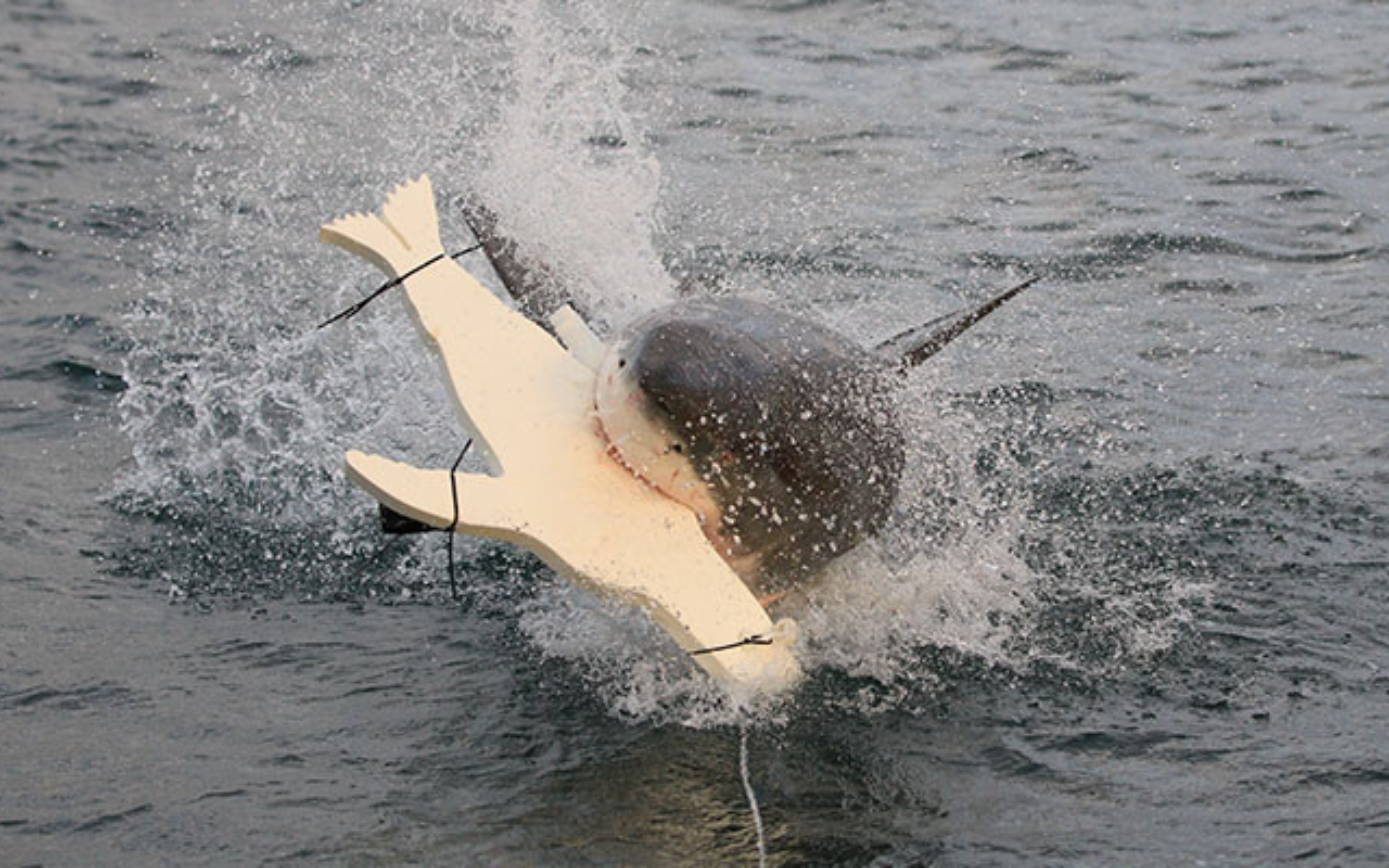
Great White sharks often identify prey by its shape or shadow rather than fine detail. Credit: Macquarie University
What sharks are particularly good at is detecting silhouettes and movement from a distance.
For species such as the Great White shark, prey is often identified by its shape or shadow rather than fine detail. This sensory limitation may explain why sharks sometimes mistake humans for their natural prey.
“For Great White sharks in particular, it can be quite difficult for them to distinguish between us and something like a seal,” she says.
Drawing on these insights from Dr Ryan’s PhD research into shark vision, she and Professor Nathan Hart from Macquarie University’s Neurobiology Lab developed a shark deterrent designed to exploit how sharks see.
It involves a series of lights embedded into surfboards, designed to alter the silhouette seen by sharks and making it less likely to resemble prey.
To test this counterillumination strategy, Dr Ryan and Prof Hart headed to the shark-rich waters of Mossel Bay, South Africa.
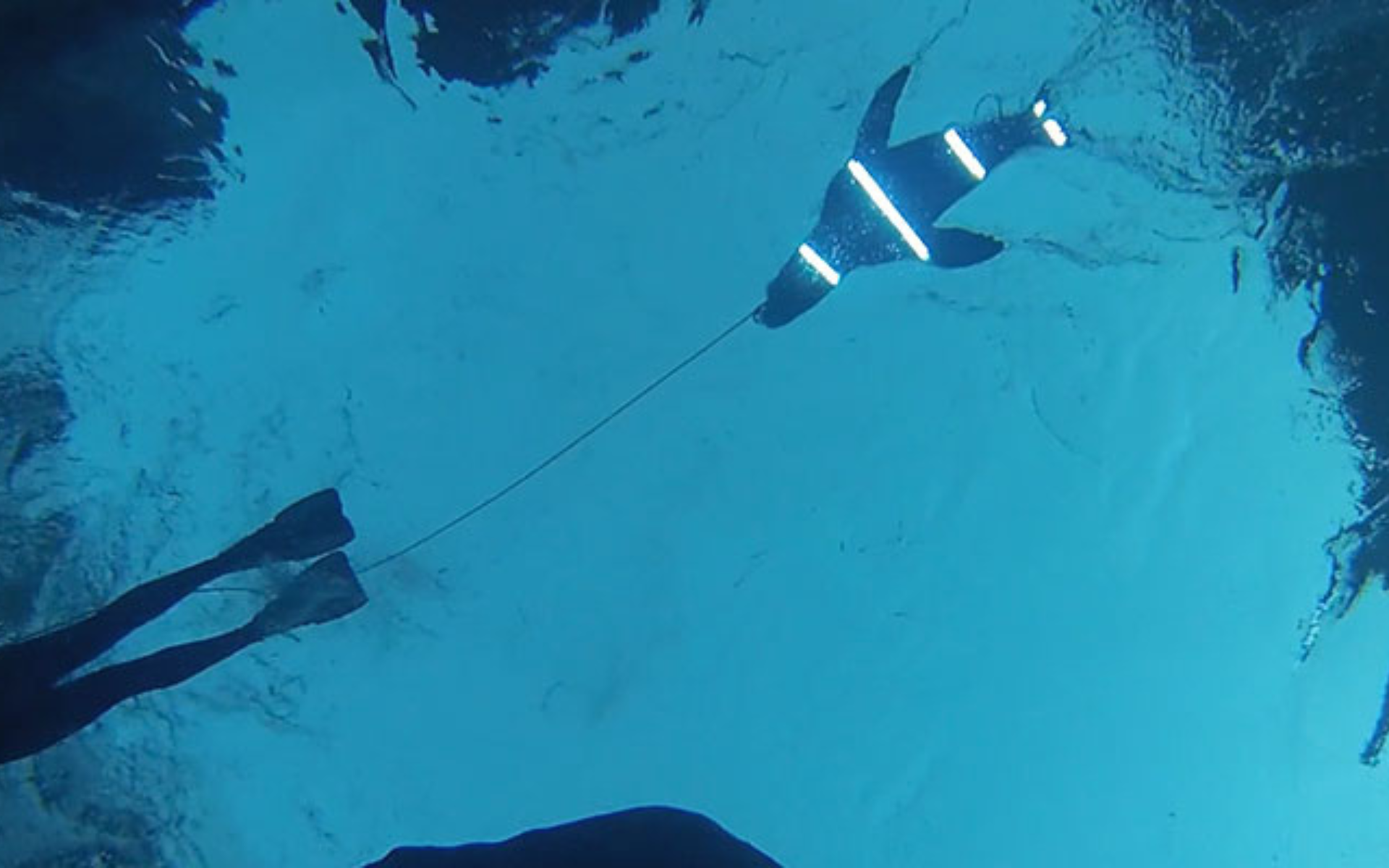
The Macquarie researchers towed 1.2-metre seal-shaped decoys behind a boat and found that LED lights break up the silhouette of seals into smaller shapes, making them harder for sharks to recognise as prey. Credit: Macquarie University
There, they towed 1.2-metre seal-shaped foam decoys on a 20-metre line behind a boat, fitting some with LED lights in a variety of configurations including flashing patterns and full coverage.
The results were striking.
“When we added lights to the seal decoys, it significantly reduced the number of interactions with white sharks,” Dr Ryan says.
After extensive experimentation, the researchers discovered the most effective configuration was lights in stripes across the bodies of the seal decoys, perpendicular to the direction they were being towed through the water.
“Our best-performing design was never breached by a white shark during the trials,” she says.

Professor Nathan Hart, left, and Dr Laura Ryan, right, hope to develop surfboards with lights underneath to deter sharks. Credit: Macquarie University
The researchers used seal-shaped decoys rather than surfboards as this is a more powerful visual cue as it is more similar in shape to seals.
While the study did not directly test lights mounted on surfboards, Dr Ryan – herself a surfer - says there is no reason the system would not work when applied to surfboards.
The findings are now progressing toward commercialisation, with Dr Ryan working toward launching a spin-off company developing surfboards with embedded LED lights.
“We’ve already filed patents and we’re hoping to launch soon,” the sensory biologist says.
Dr Ryan hopes the technology could also eventually be used by paddleboarders, kayakers and surf lifesaving organisations.
She says the approach of first understanding an animal’s sensory system and then using that knowledge to influence behaviour could be applied to other marine species.
For example, bull sharks appear to rely more strongly on electrical cues, an area the Neurobiology Lab is now investigating for potential deterrent technologies.
The same sensory-based approach is also being used to address issues such as light pollution in marine environments.
“We often think about light pollution in terms of how bright it looks to us, but animals perceive light very differently.”
By understanding how species detect colour and light intensity, researchers can design lighting solutions which reduce ecological impacts.
One example is the use of red lighting near turtle nesting sites.
“In many places, red lighting is used near turtle nesting sites for human safety because turtles are less sensitive to it,” she says, adding the approach helps hatchlings navigate safely to the ocean.
Dr Ryan says conservation strategies are far more effective when they consider how animals perceive the world.
“We need to look at the scenario through their visual, olfactory and electroreceptive abilities, rather than our own,” she says.
“It kind of blew my mind that different animals experience completely different worlds depending on how they see. I was fascinated by the idea of trying to view the world through different eyes.”