
Smart sensing critical to Australia’s future security and resilience, NSSN Co-Director says
NSW Smart Sensing Network Co-Director Professor Benjamin Eggleton has warned Australia is entering a more unstable and technologically competitive era, where smart sensing technologies, photonics, semiconductors and AI are becoming critical to national security, sovereign capability and future economic resilience.
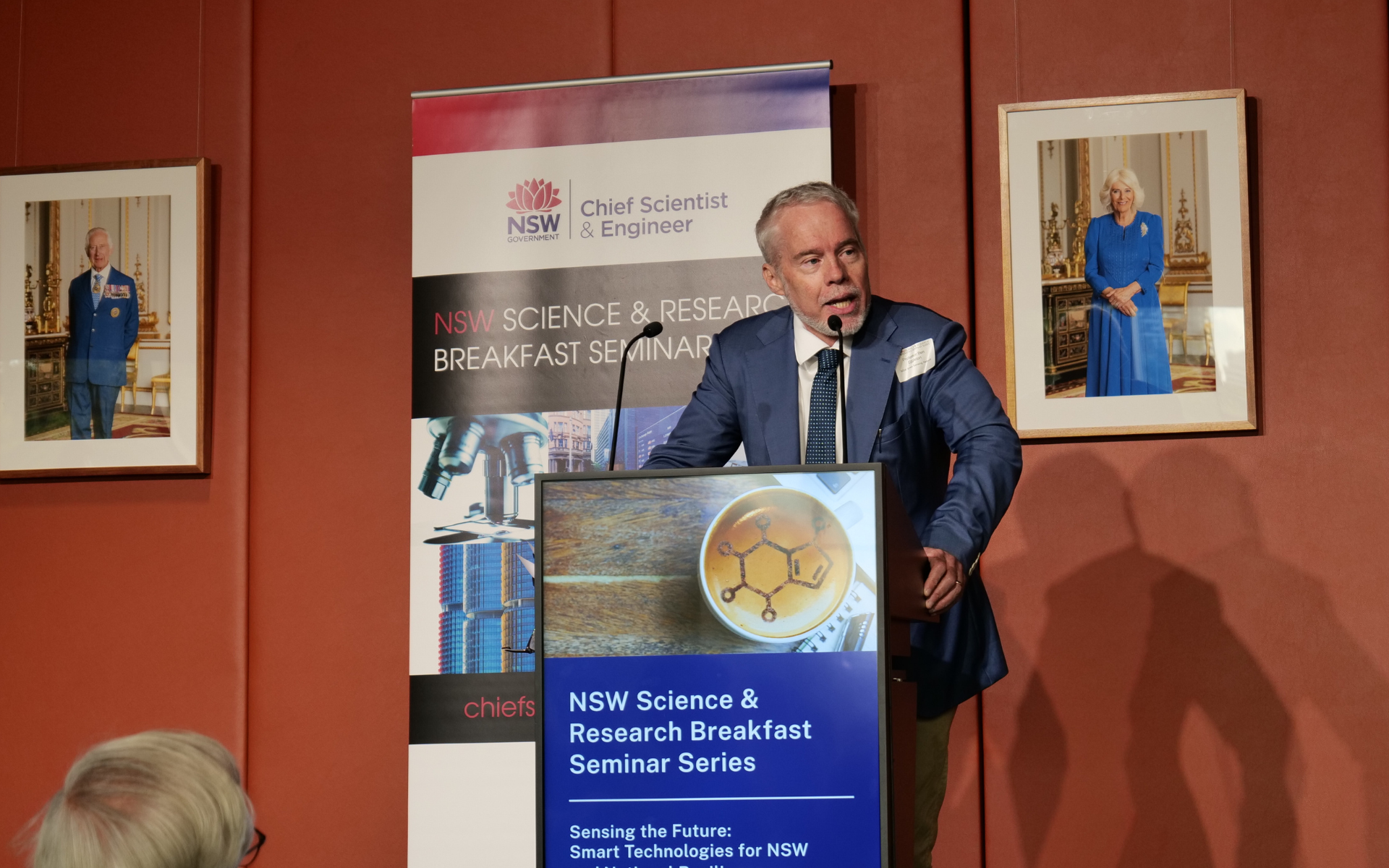
NSSN Co-Director Professor Benjamin Eggleton
Speaking as part of the NSW Science & Research Breakfast Seminar Series at NSW Parliament House earlier this month, Prof Eggleton said growing geopolitical instability, climate pressures and the accelerating global technology race were driving renewed national focus on advanced manufacturing and technological capability.
“The world is becoming increasingly complex…and we are increasingly blind without sensing systems,” Prof Eggleton said.
In his speech, Sensing the Future: Smart Technologies for NSW and National Resilience, he described smart sensors as increasingly embedded in everyday life, underpinning productivity, healthcare, communications and defence as advances in semiconductors, photonics and AI reshape industries and national capabilities.
“This is serious stuff,” he said, pointing to growing emphasis on “sovereign capability and manufacturing in a way that I think we haven’t had since World War II”.
He said stronger collaboration between universities, government and industry through initiatives including the NSSN, semiconductor programs and smart sensing laboratories are helping accelerate Australia’s capability in areas critical to defence, national security and future prosperity.
Using NASA’s recent Artemis II mission as an example of smart sensing in action, Prof Eggleton described the spacecraft as a test bed for next-generation sensing technologies.
“Artemis II was loaded with advanced smart sensors on the inside to keep astronauts healthy; on the outside to measure radiation and to provide navigation,” he said.
Prof Eggleton has spent more than three decades working in photonics and smart sensing, beginning as a PhD student at the University of Sydney before leading pioneering fibre optic research, working at Bell Labs in the United States on technologies underpinning the modern communication systems, and later establishing major photonics and nanoscience research centres in Australia.
Photonics, AI and the rise of smart sensing
Prof Eggleton said advances in semiconductors, photonics and AI were driving a new generation of connected smart sensing systems across healthcare, infrastructure, defence and autonomous technologies.
Unlike traditional sensors, smart sensors combine sensing, embedded computing, connectivity and AI to interpret information in real time, providing situational awareness that supports faster decision-making by human operators in combination with autonomous systems.
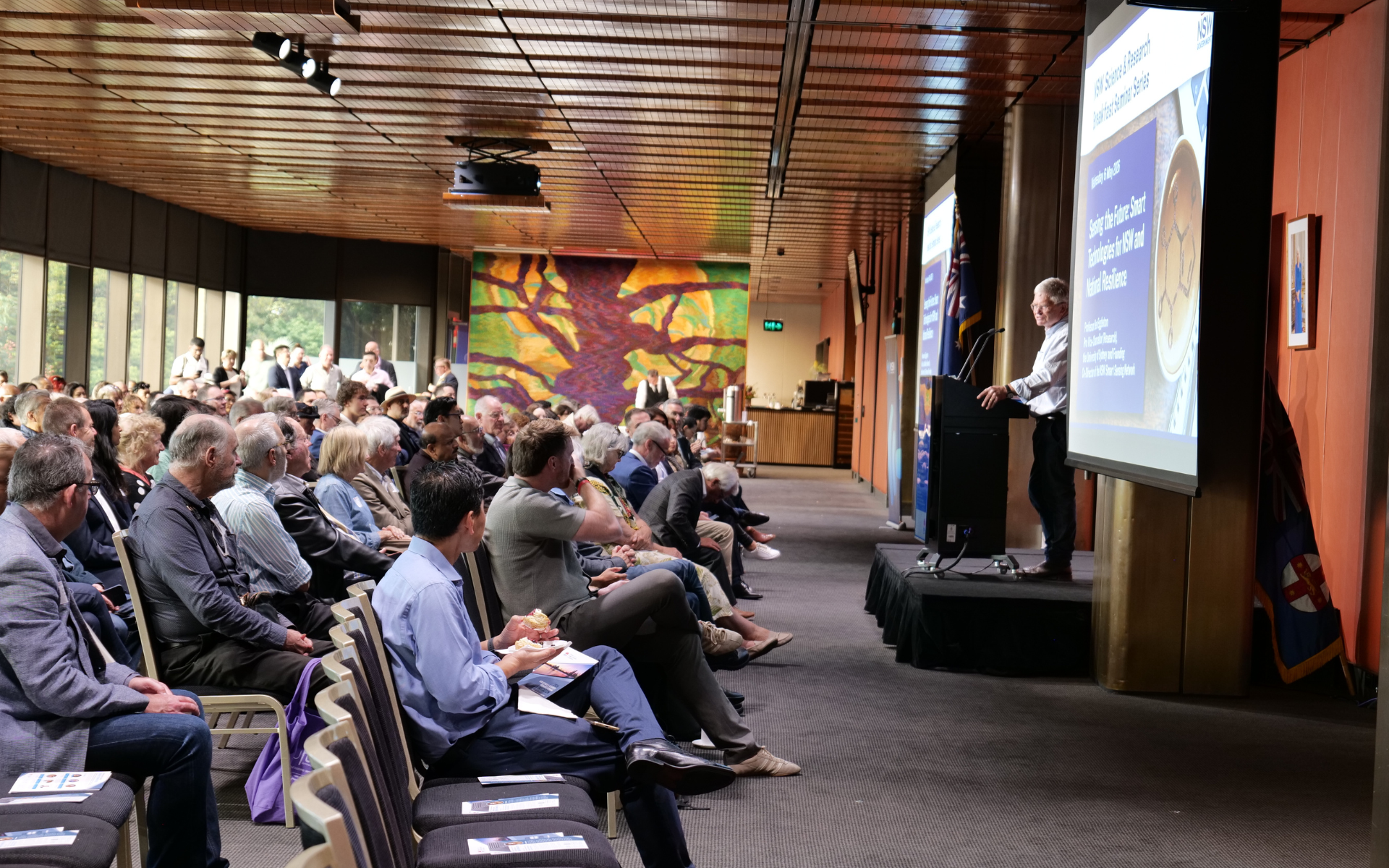
The OCSE Breakfast Seminar was opened by the NSW Chief Scientist & Engineer Prof Hugh Durrant-Whyte
“A smart sensor speaks to a sensor where we’ve added connectivity and intelligence,” he said. “It’s really that the AI provides that situational awareness that informs some type of operator or end user what action to take.”
Prof Eggleton said this growing “situational awareness” capability speaks to the ability to detect, interpret and anticipate changes in an environment, with multiple sensors increasingly working together through “sensor fusion” systems.
“Individual sensors will see fragments of the world,” he said. “Fusion integrates, cross-checks and complements those views, reduces uncertainty and fewer blind spots.”
Rapid advances in sensing technologies had been enabled by decades of growth in semiconductor computing power and photonics - the science of controlling and manipulating light, he said.
Photonics now underpins more than $10 trillion of economic activity globally and plays a critical role in Australia’s digital infrastructure, including the National Broadband Network and the fibre optic systems connecting Australia to the world.
“If you had no photonics, you had no connectivity, you had no prospect for AI,” he said. Prof Eggleton said emerging silicon photonics technologies were now allowing advanced photonic sensing systems to shrink from tabletop-scale devices onto thumbnail-sized chips, dramatically reducing size, weight and power requirements.
From photonic radar to sovereign capability
Prof Eggleton’s research has focused on translating advanced sensing and photonics research into practical applications through industry collaboration, infrastructure development, commercialisation and national security initiatives including the Jericho Smart Sensing Laboratory at the University of Sydney.
He said a contactless photonic radar system developed by his research team was capable of remotely monitoring breathing and heart rates without wearable devices.
Initially tested on cane toads as biological stand-ins for humans, the technology has since been patented, supported through the NSW Government’s SBIR program and commercialised through a spin-out company.
“We are not saving New South Wales from cane toad evasion,” he said. “The cane toad is a proxy for a human.”
He said the photonic radar system could be used in hospitals, aged care, burns units and corrective services where wearable monitoring devices may not be practical.
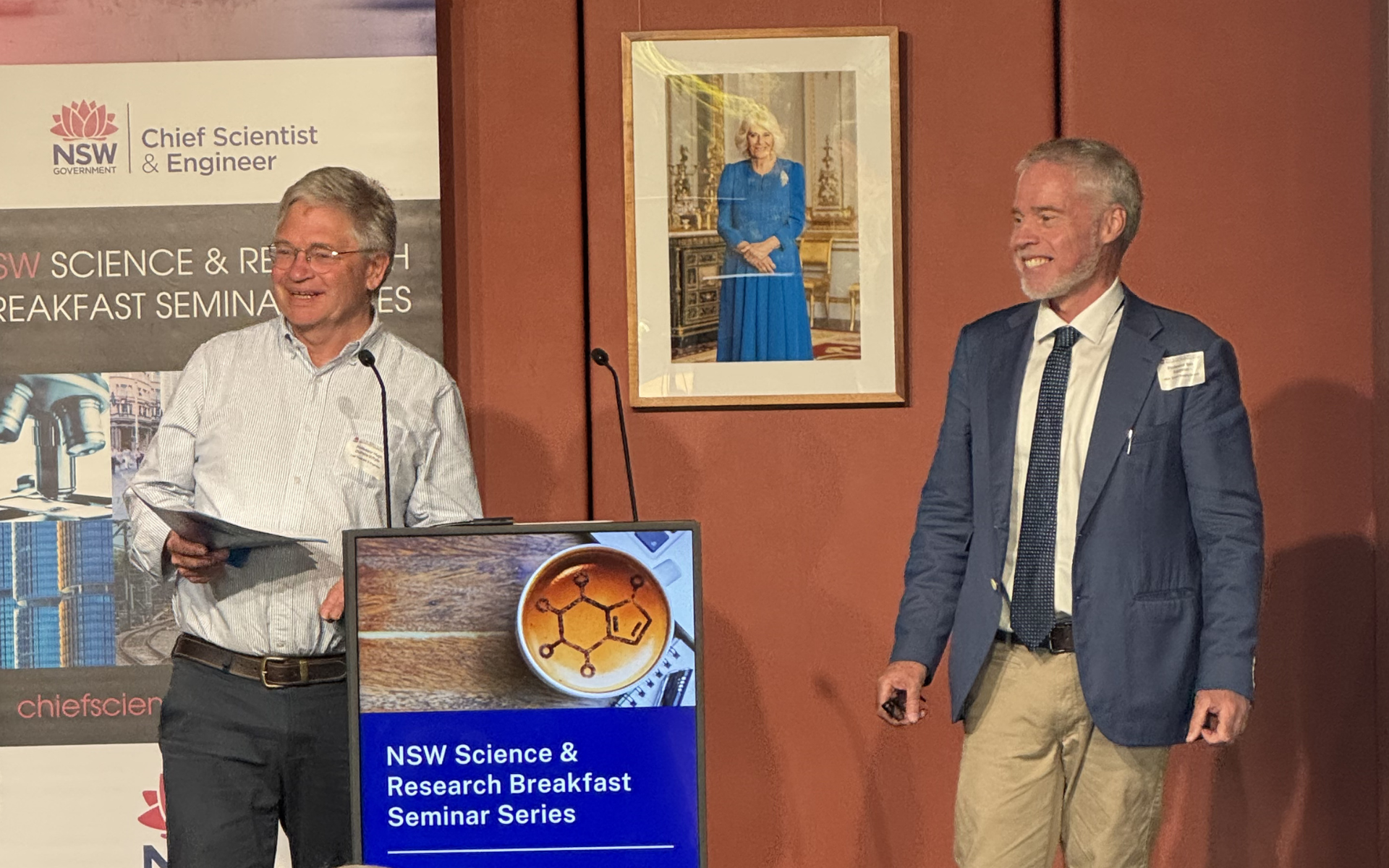
(L-R) Prof Durrant-Whyte and Prof Eggleton
Other sensing projects underway include photonic radar systems for drone detection, neuromorphic sensors for fertility applications and advanced acoustic sensing technologies.
Prof Eggleton said smart sensing technologies were increasingly being applied to major global challenges including environmental monitoring, healthcare, energy management and national security.
Collaboration between universities, government and industry was critical to accelerating Australia’s innovation capability in areas vital to future economic prosperity and sovereign capability.
Reflecting on co-founding the NSSN almost a decade ago, Prof Eggleton said the network of seven universities was established to bring together researchers, industry and government to tackle sensing challenges across areas including environmental monitoring, water infrastructure and natural hazards.
“(The NSSN) was born with the idea of a New South Wales government-sponsored innovation network to bring together universities… to accelerate smart sensor capability into solutions that address those real-world problems,” he said.
He said the network’s work with Sydney Water detected leaking pipelines using technologies such as quantum sensors, LiDAR and acoustic sensing. The NSSN had also helped lead national conversations around bushfires, floods, advanced manufacturing and Australia’s industrial capability.
Prof Eggleton also highlighted the Royal Australian Air Force-backed Jericho Smart Sensing Laboratory, established in 2019 to accelerate sovereign capability in advanced sensing technologies for national security applications.
The program brings together scientists, designers and defence end users to develop sensing technologies tailored to operational needs in an increasingly unstable geopolitical environment.
Quoting Australia’s National Defence Strategy, Prof Eggleton said advances in AI, autonomous systems and sensing technologies were now “absolutely vital to our national security”.