
How the NSSN turns sensing research into commercial reality
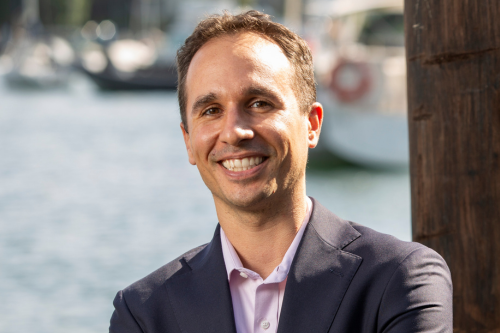
NSSN Board Member Loïc Barancourt
Australia is home to world-leading smart sensing research, yet many promising technologies struggle to achieve commercial scale. In this Thought Piece, tech executive, IoT Scale-Up leader and NSSN Board Member Loïc Barancourt explores one of the sector’s greatest challenges: turning technical excellence into commercial success, arguing that industry engagement and market validation must be embedded from the earliest stages of research.
Australia has world-class smart sensing research.
We have brilliant scientists, well-funded university networks, and government programs increasingly aligned behind the opportunity.
The challenge for most research organisations is finding a reliable and consistent way to scale commercially.
This aligns with the pattern I’ve seen repeatedly.
Having led IoT and sensing businesses across Australia and globally, what strikes me again and again is this: the research works. The technology is real, often superior. However, the market doesn’t follow.
That’s not a research problem. It’s a commercialisation and go-to-market problem.
And until we name it clearly, we’ll keep celebrating technical milestones while leaving economic value on the table.
The question we don't ask early or rigorously enough
Somewhere between the lab and the market, a critical question gets asked too late, and too loosely: how will we actually sell this?
What’s striking is that the scientific world, rigorous about hypothesis testing in the lab, rarely applies that same discipline to market validation.
Testing whether a customer will actually buy, at what price, through which channel, is treated as too trivial to warrant serious attention at the early stages of a research project. It isn’t. It’s the part that determines whether the work pays for itself.
Too often, it gets a short, vague answer. The technology we research will be superior.
Here’s the size of the total addressable market, someone somewhere will see its value and buy it. But superiority is not a go-to-market strategy.
Creating a great sensor and hoping commercial applications will present themselves is not enough anymore.
The path to market is longer and more expensive than almost anyoneanticipates the first time they walk it.
Enterprise buyers don’t buy sensors. They buy outcomes, risk reduction, and integration with systems they’ve already spent millions on.
Integrating new sensing technologies into the ecosystems these enterprises already run can take years, delaying sales cycles and, often, outlasting the funding cycles meant to see the technology to market.
What actually works
There are multiple levers for increasing the chances of achieving product-market-channel fit and related successful commercial outcomes.
But the most powerful thing you can do is place a real customer and their real pain at the centre of research and development.
Not at the end of the process, not at the commercialisation stage, not even at the productisation stage: I’d push for earlier than that – as early as possible in the research process.
The most effective version of this is not one operator co-developing with a research team, but multiple operators and their ecosystems rallying around the same problem.
This matters for several reasons: research becomes easier to fund and scope, the solution gets stress-tested against a broader range of real-world conditions, and the resulting technology is fit for a wider market than if a single operator’s needs had dictated the brief.
That’s the difference between building a bespoke tool and building an industry capability.
Why the NSSN model matters
This is precisely what the NSW Smart Sensing Network does so well, and why it deserves recognition not just as a research network, but as a commercialisation engine.
By structurally connecting researchers with multiple industry and government partners around shared operational challenges, the NSSN embeds the customer into the innovation process from the start.
That is not the norm in research ecosystems. It should be.
The impact of this model is already evident. The NSSN’s Advanced Pipe Sensing project began with an initial R&D investment of just $100,000 from Sydney Water.
Through the network’s ability to bring together utilities, researchers and industry around a common challenge, that investment grew into a $3.4 million collaborative R&D project involving eight water utilities, five NSSN member universities and four multidisciplinary work packages.
The resulting technologies are now delivering ongoing savings to Sydney Water of around $3 million per year, while helping prevent the loss of 600–700 million litres of water annually.
The next step is measurement. We tend to celebrate inputs such as dollars invested in R&D, patents filed, papers published. These matter.
But if Australia is serious about capturing economic value from its sensing capability, we need to track commercial outcomes with equal rigour: revenues generated, companies formed, solutions deployed at scale.
What gets measured gets prioritised. And commercialisation needs to be a priority, not an afterthought.
The research is there. The model is there. Now we need to scale the commercial ambition to match.