
From lab to paddock: how science and industry meet on the TRL ladder
Agriculture increasingly depends on fast, practical decisions, yet many sensing technologies remain confined to the laboratory. This Thought Piece outlines how Nanotechnologist at Macquarie University, Professor Noushin Nasiri, and Founder of agritech/biotech Agscent, Dr Bronwyn Darlington, are collaborating to develop future agricultural sensing applications, including methane monitoring and early disease detection in livestock. Their work focuses on translating advanced sensor science into on-farm tools through ongoing feedback between research and industry along the Technology Readiness Level (TRL) pathway.
On a farm, decisions often need to be made long before a laboratory result comes back.
Is this animal pregnant? Is it stressed or unwell? Is something changing in the herd before visible signs appear?
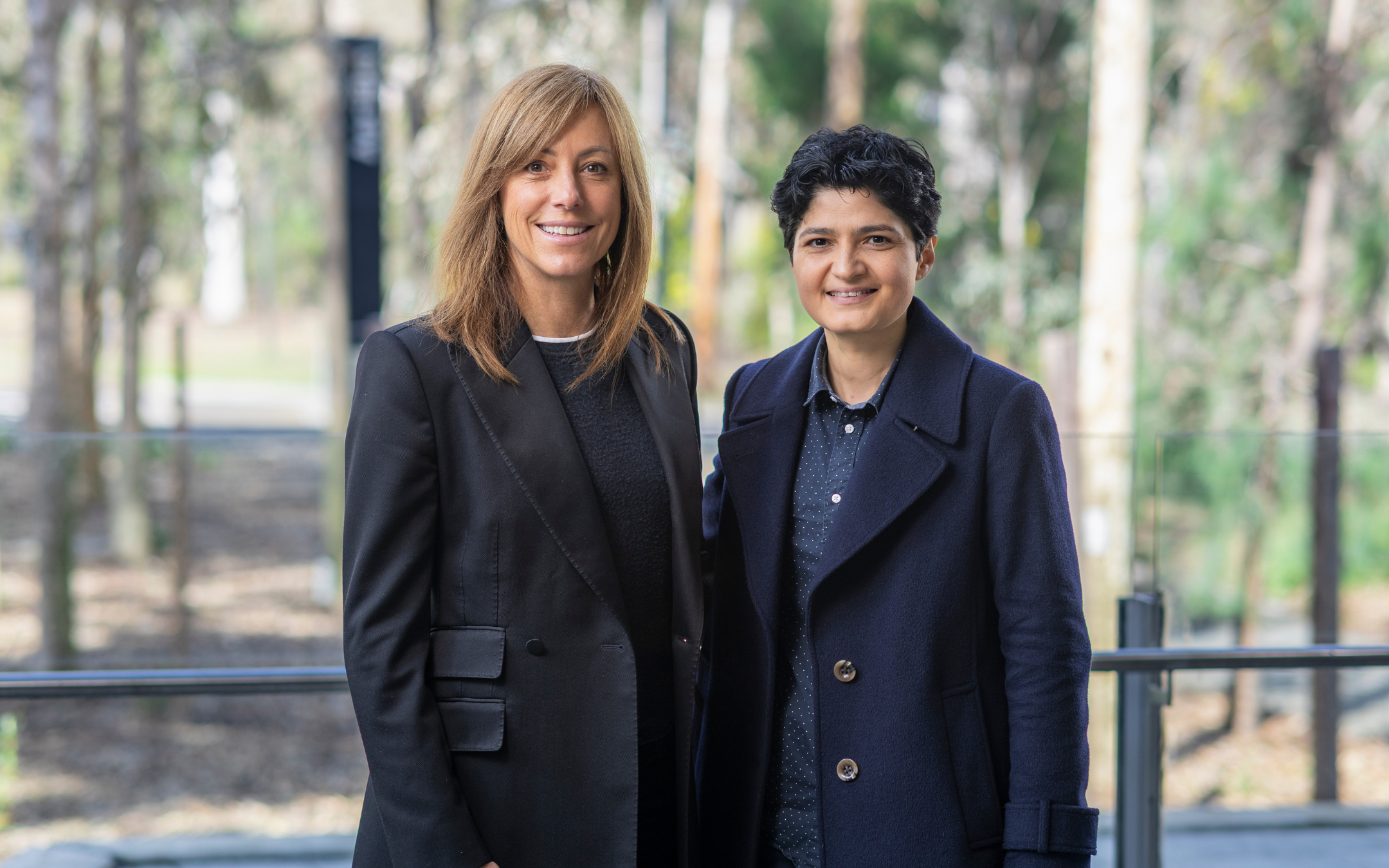
Dr Bronwyn Darlington (left) and Professor Noushin Nasiri. Credit: Supplied
Can methane emissions be monitored in a way that is practical, affordable, and useful for producers?
These are not abstract scientific questions, they are everyday challenges for Australian agriculture.
And they are exactly the kinds of problems that cannot be solved by science or industry alone.
Our collaboration between Macquarie University’s NanoTech Laboratory and Agscent began at this intersection: where advanced sensing science meets the realities of livestock industries.
From the university side, our team has been developing nano-engineered sensing technologies capable of detecting gases and volatile organic compounds — tiny chemical signals that can carry valuable information about health, physiology, and the environment.
In the lab, these sensors begin as materials: nanostructured films, engineered interfaces, and device architectures designed to respond to specific chemical environments.
At that stage, the work is precise, controlled, and highly technical.
We tune materials, test responses, improve sensitivity, and ask how a molecule interacts with a surface and how that interaction can be translated into a measurable signal.
But the real world is not a controlled chamber.
The paddock is humid, dusty, variable, and chemically complex. Biological signals are subtle. Background gases interfere.
Animals do not behave like laboratory samples. A sensor that works beautifully under controlled conditions still has a long way to go before it can become a useful technology for farmers, veterinarians, or industry.
That is where Agscent brought the other side of the story.
For Agscent, the starting point was not a nanomaterial. It was a national problem.
Australian livestock industries need faster, less invasive, and more practical tools to support animal health, reproductive management, productivity, and sustainability.
Video shows Agscent’s breath collection system for cattle, a non-invasive tool that captures animal breath for later analysis of health indicators. This system will support the future use of advanced sensors being developed with Macquarie University’s NanoTech Laboratory once they are commercialised. Credit: Agscent
Agscent understood the industry need, the end-user environment, and the commercial reality. They knew what a technology would have to survive, prove, and deliver before it could matter outside the laboratory.
That industry perspective changed the questions we asked.
Instead of only asking, “Can the sensor detect this molecule?”, we began asking, “Can it detect the right signal in a complex real-world environment?”
Instead of only asking, “Is the response strong?”, we asked, “Is it selective, stable, repeatable, and useful?”
Instead of only asking, “Can we publish this?”, we asked, “Can this become something someone can use?”
That shift is at the heart of climbing the Technology Readiness Level, or TRL, ladder.
The TRL journey is often shown as a neat progression from idea to product. In reality, it is much more like a conversation.
Science moves forward, industry pulls it back to reality, and the problem becomes clearer.
A field requirement may send the research team back to redesign a material. A sensor result may reveal a new commercial possibility. A challenge around humidity, selectivity, or sample variability may open a new scientific question.
In our collaboration, this back-and-forth has been one of the most valuable parts of the process. The science has not simply been “handed over” to industry; it has been shaped with industry from the beginning.
Macquarie University’s NanoTech Laboratory brings expertise in nanomaterials, sensor fabrication, device design, and analytical testing, while Agscent brings deep knowledge of livestock systems, end-user needs, and translation pathways.
Together, we have been able to view the same challenge from two directions: from the molecule up, and from the farm gate back.
For us, the TRL ladder has never been just a technical scale. It has been a shared learning process built on trust, patience, and a willingness to ask practical questions early.
From the science side, the goal is to see sensing platforms leave the laboratory and contribute to real-world solutions.
From Agscent’s side, the goal is to bring better diagnostic and monitoring tools to Australian agriculture.
The real innovation happens where those two directions meet.
And perhaps that is the most important lesson from our journey so far: climbing the TRL ladder is not only about moving technology closer to market.
It is about moving people closer together - scientists, industry partners, farmers, and end users - so that the technologies we build are not only clever, but useful.
In the end, the goal is not just to make a better sensor, but to make better decisions possible, sooner, in the places where they matter most, and to build the pathways that will allow Macquarie’s innovations to reach those environments in the future.
We hope the future outcome of this work is a portable sensing module which can be integrated into Agscent’s existing arrays.
This capability is expected to enhance the specificity and selectivity of key applications such as methane monitoring and early disease detection, enabling faster and more informed decisions at the farm level.
Professor Nasiri and Dr Darlington will deliver a keynote speech about their experience of climbing the TRL ladder at the Sensing meets Semiconductors event at Macquarie University’s North Ryde Campus on Wednesday 20 May. The event is being hosted by the NSSN and the Semiconductor Sector Service Bureau.