
Professor Sean O'Byrne is Professor of Aerospace Engineering at The Australian National University, where he develops advanced laser-based diagnostic and sensing techniques to better understand hypersonic flows, combustion, plasmas and other high-speed aerospace environments. An internationally recognised expert in aerospace diagnostics, his research is enabling more accurate measurements that support the development of next-generation aerospace technologies. Prof O’Byrne is also the NSSN Ambassador for the ANU.
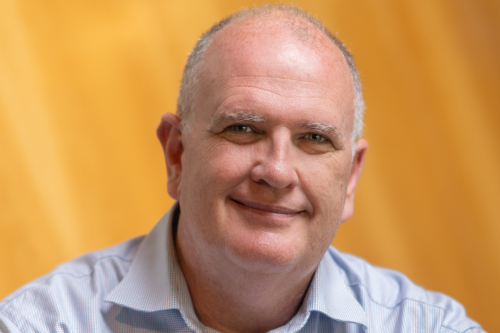
Professor Sean O’Byrne. Credit: Supplied
Tell me about your interest in aerospace technologies.
Aerospace engineering is an exciting field, at least to me, because it presents a number of interesting challenges for an instrumentation engineer, particularly when it comes to very high-speed flows like those around hypersonic aircraft and atmospheric entry vehicles. The combination of high pressures and temperatures, vibration and the problems associated with using intrusive sensors from the subsonic flight regime provide excellent opportunities to exercise creativity in measurement. I have been working in this field for 30 years this year, and it has not lost its interest for me yet!
What’s been your most rewarding achievement or moment in your career?
My most rewarding achievement was probably completing my PhD. That was a great deal of work, and I was not sure whether I was capable of making the required unique contribution to the field. Probably the most memorable moment was when, with my student Robert Hruschka and colleague Harald Kleine, we first saw the very rarefied flow in the wake of a model entry vehicle using a technique we had developed that was much more sensitive than previous flow visualisation techniques. Knowing that we were the first people who had seen these flow features at these conditions was special. But it’s rewarding every time I and my colleagues develop a new technique that works well.
What more are you hoping to achieve in your career?
There are many challenges still to be met. I would like to make some high-quality measurements of vibrational nonequilibrium processes in hypersonic flows. These measurements are difficult to make and take a long time to validate, but current computational models of thermal nonequilibrium depend on a very small number of measurements, and I believe that the technologies for pushing the state of the art of modelling in this area are available to experimentalists now that we have high quality laser spectroscopic techniques available to us.
In addition to this personal goal, during my remaining career I want to help as many young researchers achieve excellence in the aerospace engineering field as I can, both at undergraduate and postgraduate levels. I received a lot of help from my mentors and I’d like to offer the same for my students and junior colleagues.
Why is what you do important?
Building sensors for high-speed flight of air vehicles and satellites is an enabling technology. To be able to manoeuvre a vehicle at high speeds, sensors need to be fast and nonintrusive. To determine when a satellite in very low earth orbit will re-enter the atmosphere requires methods to measure the local air density that operate in very low-density conditions. In addition, we really do not understand the complexities associated with the storage of internal energy by molecules as high-speed vehicles move through the air. Knowing these properties enables reliable high-altitude flight on earth and the exploration of other planets.