
A Grand Challenge Fund project has demonstrated that high-energy ultraviolet radiation can break down PFAS ‘forever chemicals’ in contaminated water, opening the door to a potential new way of treating some of Australia's most persistent pollutants.
The project led by researchers at The Australian National University successfully demonstrated the technology's ability to degrade PFOA, a carcinogenic type of PFAS, with laboratory experiments reducing its concentration by approximately 34 to 37 per cent after an hour of treatment.
The findings provide proof of concept for a technology that could eventually be integrated into existing water treatment plants, helping destroy concentrated PFAS waste rather than simply removing it from water and leaving it to be disposed of or stored.

Dr Josef Richmond. Credit: Supplied
Co-Lead researcher Dr Josef Richmond, who conducted the research as a PhD candidate at ANU’s Space Plasma, Power and Propulsion Laboratory, says the findings demonstrate a new application for technology originally developed to simulate the harsh radiation conditions of space, allowing scientists to test years of solar radiation exposure on materials in just hours or days.
“We’ve demonstrated that high-energy ultraviolet radiation can break down PFOA, a known carcinogen and one of the most persistent types of PFAS found in water,” says Dr Richmond, now a Forrest Fellow at the University of Western Australia’s School of Molecular Sciences.
A new approach to destroying PFAS
PFAS (per- and polyfluoroalkyl substances) are a group of synthetic chemicals widely used in firefighting foams, non-stick cookware and other products because of their resistance to heat, water and oil.
Their exceptionally strong chemical bonds make them difficult to destroy, earning them the nickname ‘forever chemicals’.

Close-up of the prototype low-wavelength radiation source used to degrade PFAS in water. Credit: Jamie Kidston, ANU
The ANU technology uses a hydrogen plasma source to generate high-energy vacuum ultraviolet (VUV) radiation, which can break down the chemical bonds in PFAS.
“Unlike some existing UV-based PFAS treatment methods, our technology doesn't require any additional chemicals or catalysts to break down contaminants. We simply expose the PFAS-contaminated water to high-energy ultraviolet radiation to break down the chemicals,” Dr Richmond said.
The experiments also used PFOA concentrations far higher than those typically found in drinking water, suggesting the technology could be particularly suited to treating concentrated PFAS waste captured by existing water filtration systems.
Mr Richmond says it could offer a way to destroy the captured chemicals rather than simply transferring the contamination elsewhere.
“Once PFAS has been filtered out of the water, our technology could help destroy it, rather than simply leaving the contamination problem in another form,” Dr Richmond said.
Overcoming the technical challenges
While the experiments reduced PFOA concentrations by 34 to 37 per cent, they also produced shorter-chain PFAS compounds that require further treatment to break down.
A key challenge is that the radiation only penetrates a thin layer at the water's surface, limiting how efficiently larger volumes can be treated.
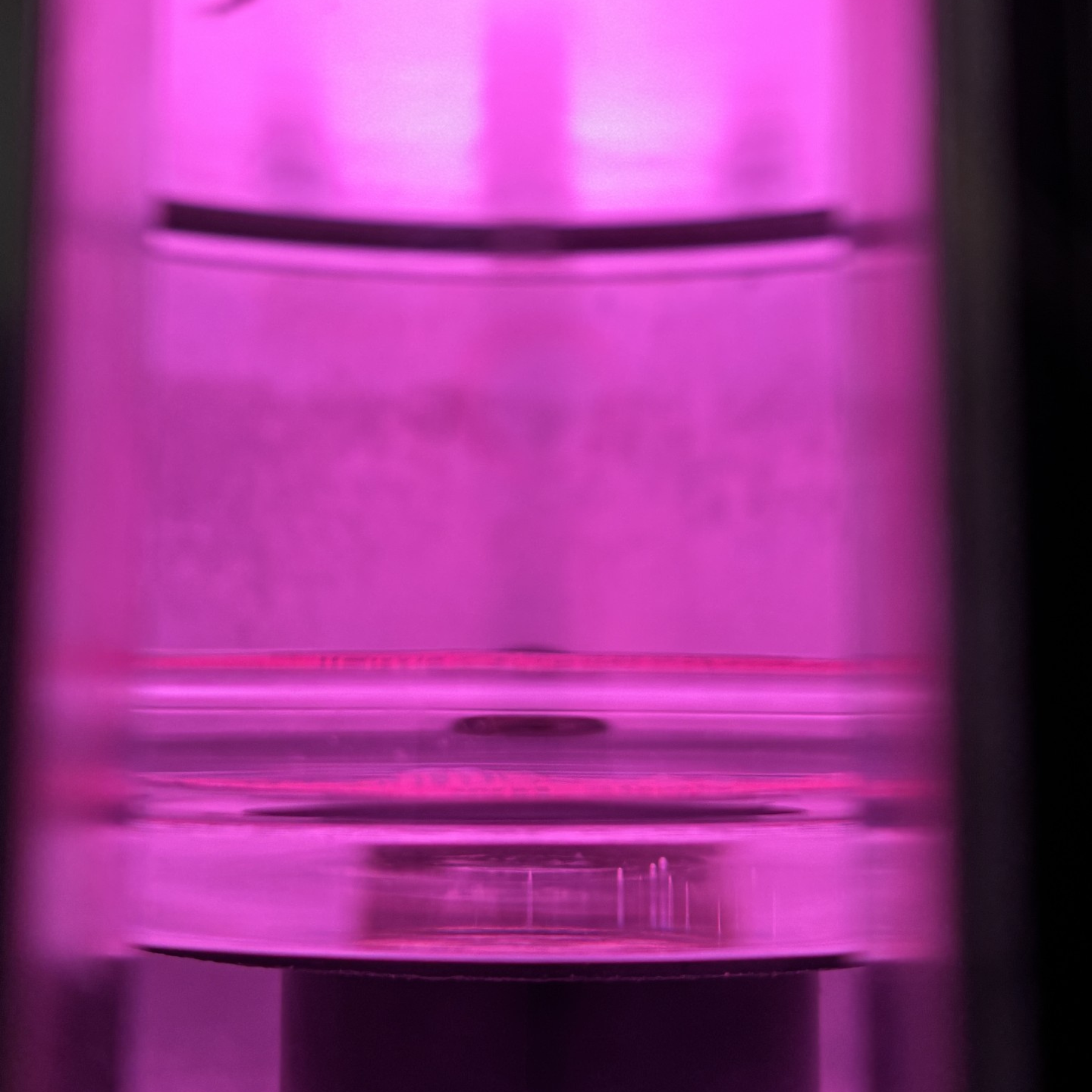
PFAS contaminated water samples undergoing the photolytic decontamination process in the project. Credit: Josef Richmond
To overcome this, researchers plan to develop a microfluidic reactor that continuously pumps contaminated water through a thin, sealed channel, exposing more of it to the radiation.
“By continuously circulating the water through the reactor, we could expose more of it to the radiation, rather than relying on natural mixing, potentially making the treatment process much faster,” Dr Richmond says.
The new design could accelerate treatment and allow the remaining PFAS compounds to be broken down further, bringing researchers closer to their goal of complete PFAS destruction.
Researchers initially estimated the technology could deliver in six minutes the radiation dose a conventional source would take 10 hours to deliver, but this is yet to translate into faster treatment.
A new reactor design could help overcome current limitations by exposing more of the water to radiation.
The project was co-led by Prof Christine Charles from the Department of Nuclear Physics and Accelerator Applications, Research School of Physics at ANU and Professor Kondo-Francois Aguey-Zinsou from the University of Sydney’s School of Chemistry.
Industry partners included the Royal Agricultural Society of NSW, Pegras, Boswell Technologies and the Agrifood Innovation Institute (AFII).
Boswell Technologies CEO Professor Rod Boswell said the results laid “a solid foundation for further commercial development of VUV light sources” for industrial water treatment.
AFII Executive Officer Meredith Thomas said the institute’s investment had helped position the team for future funding and partnership opportunities in this important area of environmental and agricultural impact.
“This project is a great example of how fundamental scientific research can be translated into practical solutions to some of society’s most pressing environmental challenges,” NSSN Environment & Agriculture Theme Lead Dr Tomonori Hu said.
“The results are an exciting step forward in tackling PFAS contamination, demonstrating the potential for technology originally developed for space research to help address a major water quality challenge. While further development is needed, this research opens up promising opportunities for real-world applications.”

PFAS is commonly used in firefighting foams. Credit: AdobeStock
Next steps
With the initial proof-of-concept experiments completed, the research team is seeking further funding and potential partnerships with water authorities to develop the microfluidic reactor.
Dr Richmond says these next steps will be critical to determining whether the technology can be scaled up for practical use.
The longer-term goal is to develop a system that could be integrated into water treatment plants, offering another way to manage PFAS contamination after it has been removed from water.